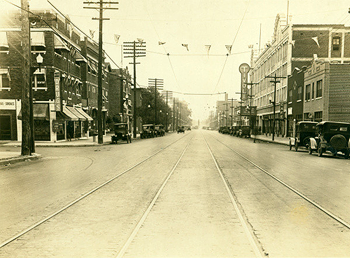
The Delmar Loop gets its name from a streetcar turnaround, or "loop", formerly located in the area. Delmar Boulevard was originally known as Morgan Street. According to Norbury L. Wayman in his circa 1980 series History of St. Louis Neighborhoods, the name Delmar was coined when two early landowners living on opposite sides of the road, one from Delaware and one from Maryland, combined the names of their home states. The town of Delmar, Delaware, on the border between the two states, derived its name in similar fashion. The Delmar Loop station, a stop on the MetroLink Red Line, is located at the eastern end of the area.
The western demarcation of the Loop is generally considered to be the U. City Lions sculptures of a male lion and a female lion on pedestals flanking Delmar immediately west of the University City City Hall. West of the lions, Delmar becomes largely residential. The eastern boundary of the Loop traditionally was the St. Louis City border, punctuated by The Delmar Lounge at the corner of Delmar and Eastgate, but the area began expanding into the city proper around 2000.
This expansion has largely been due to the redevelopment efforts of Joe and Linda Edwards, owners of Blueberry Hill, The Pageant, and Pin-Up Bowl, and the Tivoli Theater, the Moonrise Hotel, and Eclipse Restaurant. The St. Louis Regional Arts Commission completed its new headquarters on Delmar in 2003, creating performance and office spaces for theater groups. The Pageant, located across Delmar from the Arts Commission, has become one of St. Louis's main venues for mid-size popular musical performances, featuring rap, rock, and country artists, including St. Louisans Chuck Berry and Nelly.
The Loop attracts an eclectic clientele and wide variety of street life, due in part to its proximity to Washington University and dating back to the late 1960s when Streetside Records and head shops dominated the retail landscape.